Hamilton Ventura: The First Electric Wristwatch
Hamilton unveiled the Ventura on 3 January 1957 as the first battery-powered wristwatch. Its Electric 500 movement, triangular case, Elvis and today's Ventura.
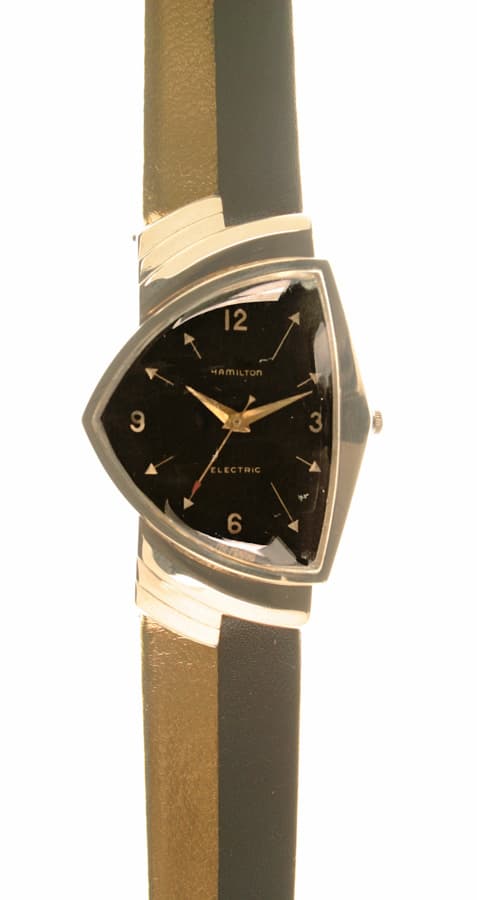
Short answer: The Hamilton Ventura was unveiled in New York on 3 January 1957, and Hamilton presents it as "the world's first electric wristwatch". Instead of a mainspring that needed winding, it ran on a small battery that powered the Hamilton 500 movement. Its asymmetric triangular case, drawn by car designer Richard Arbib, and Elvis Presley wearing one in Blue Hawaii made it a symbol of its era.
The Ventura is still made today, but the movement inside has long since changed. This story explains how the first electric watch worked, why it gave trouble, where the Ventura's case came from, and what today's Ventura is.
3 January 1957: The electric watch is unveiled in New York
Hamilton introduced its electric watch on 3 January 1957 at a press conference at the Savoy Plaza Hotel in New York, attended by more than 120 journalists. Two models were presented that day: the triangular Ventura and the round Van Horn.
About ten years of work lay behind it. Hamilton's research department began working on an electric watch in 1946 under George Luckey. A design by Philip Biemiller and James Reese was chosen, and a team led by John Van Horn turned it into a wristwatch. The battery was developed with the National Carbon Company, the forerunner of today's Energizer.
At the time Hamilton was still an American company making its watches in Lancaster, Pennsylvania. We follow the brand's journey from America to Switzerland in Where is Hamilton from?
How did the first electric watch work?
The Hamilton 500 was nothing like today's quartz watches. It had no transistors and no electronic circuit; like a traditional mechanical watch, it kept time with a balance wheel and hairspring. The difference was where the energy came from.
In a mechanical watch, the balance is driven by a mainspring that is wound up. The Hamilton 500 had no mainspring at all:
- A small coil was mounted on the balance wheel.
- Two permanent magnets sat below the balance.
- As the balance swung, the coil touched a contact connected to the battery. The moment current flowed, the coil became a temporary magnet, pushed against the fixed magnets and kept the balance swinging.
In effect, the balance wheel acted as its own switch. The battery was designed to last at least a year, and there was no need to wind the watch.
Why did the first electric watch have problems?
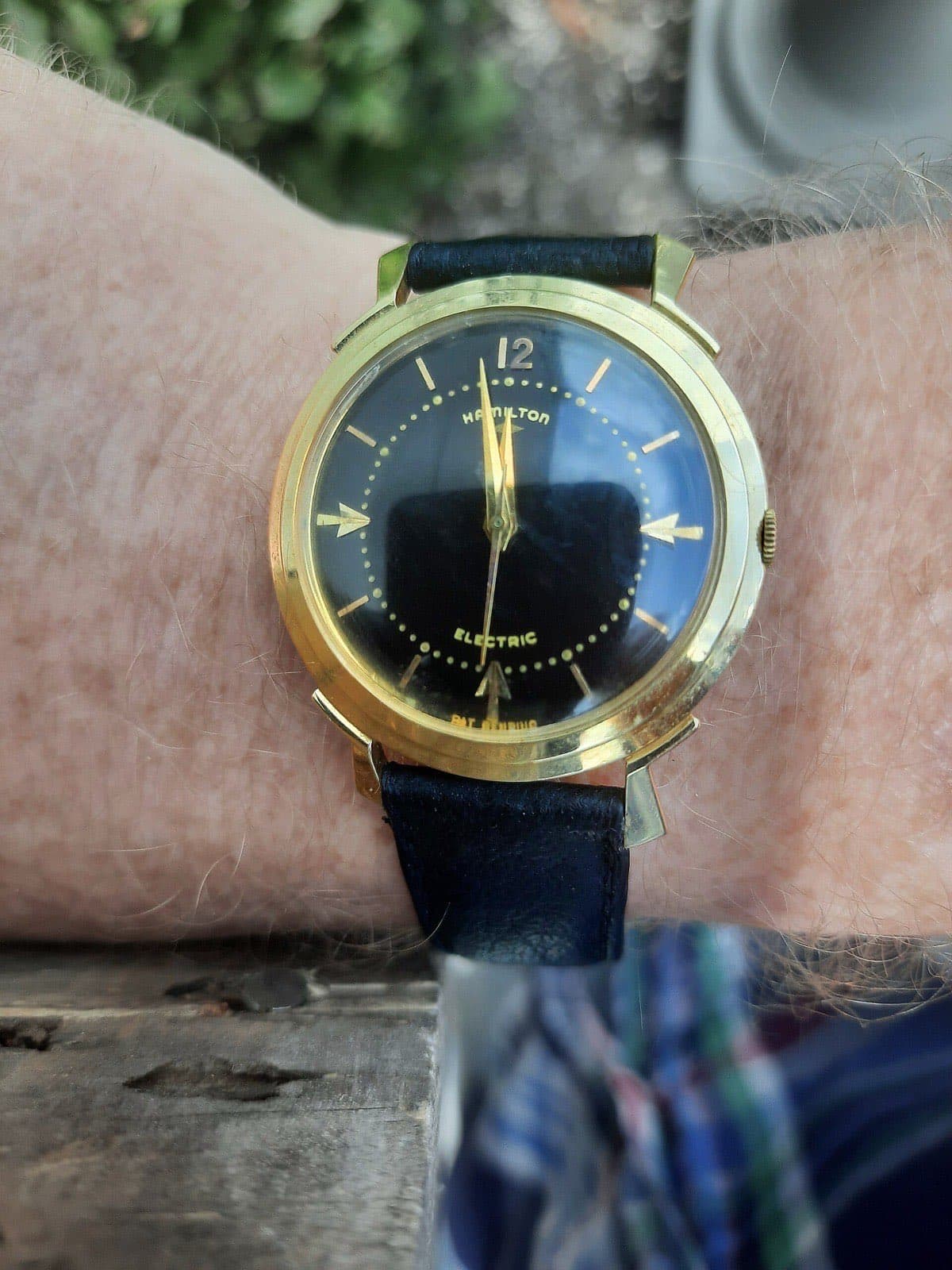
Hamilton rushed to beat its rivals to market. Bulova and Elgin were also working on electric watches: Elgin announced its watch in 1952 but could only bring it to market in 1961, and Bulova launched its tuning-fork Accutron in 1960.
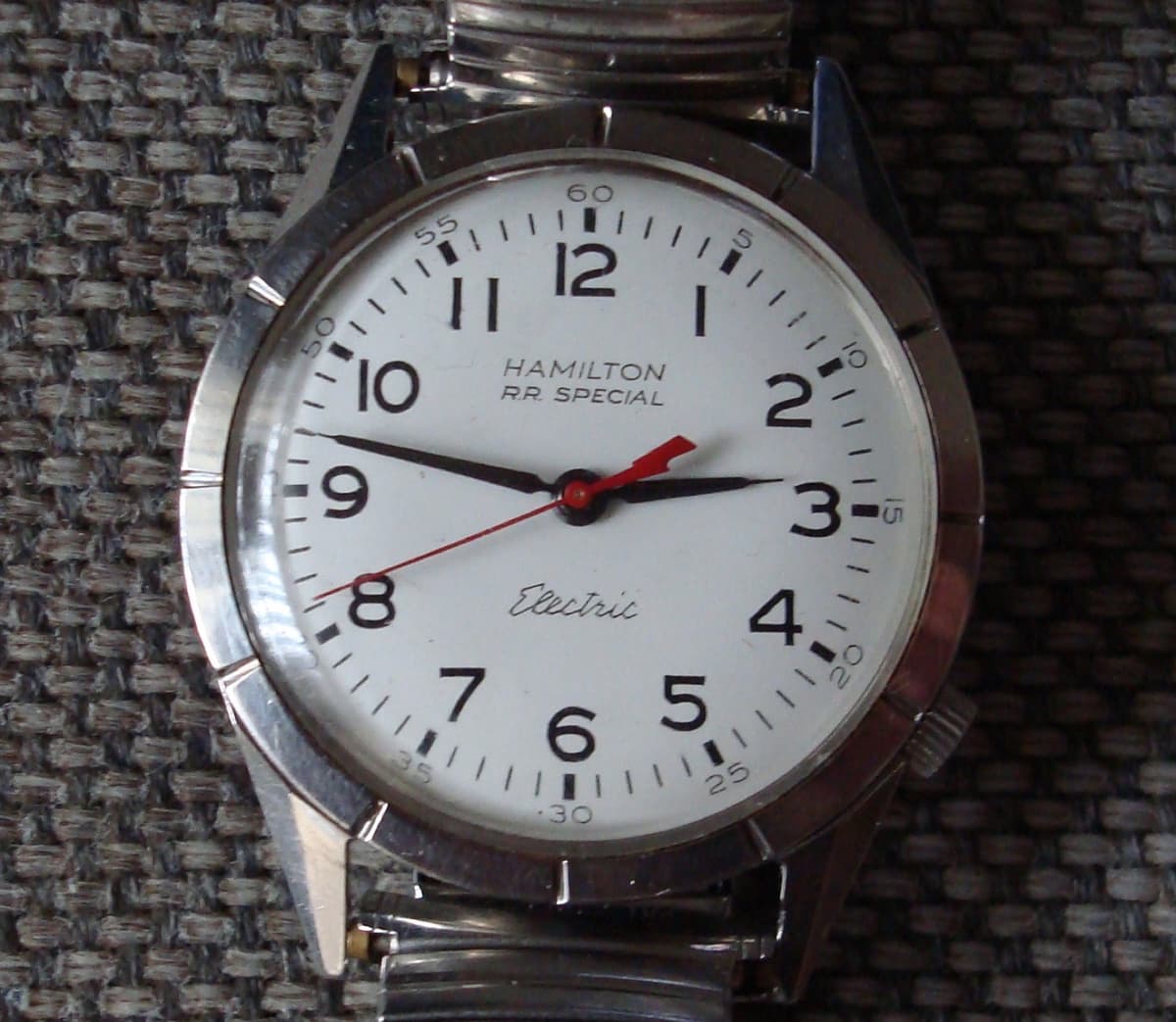
The rush came at a price. Many early Hamilton 500s were sent back because they kept stopping. The trouble lay partly in the contact system and partly in the fact that watchmakers had not been trained to service the new movement. In 1961 Hamilton introduced Calibre 505, with a thoroughly reworked contact system, which largely solved the problem.
Who designed the Ventura's triangular case?
The Ventura's case was drawn by Richard Arbib, a car designer Hamilton brought in for the job. Arbib believed the strap, case, dial and hands should be designed as one whole. In an era of round cases, the Ventura's asymmetric, shield-shaped case stood out at once.
According to Hamilton historian Jarett Harkness, Arbib admitted years later that the Ventura's shape was based on a bomb design. During the Second World War Arbib had also designed for the US military.
Elvis Presley and Blue Hawaii
The name that keeps the Ventura famous today is Elvis Presley. Elvis wore a Ventura in the 1961 film Blue Hawaii. It was more than a film prop: Elvis genuinely liked the watch, owned many Venturas over the years and gave some away as gifts. That is why the Ventura is also known as "the Elvis watch".
Rod Serling, creator of The Twilight Zone, also owned a Ventura and wore it in some episodes of the show.
The end of the electric watch
The original Ventura was made from 1957 to 1963, and Hamilton ended electric watch production in 1969. The reason was less the failure of electric watches than the arrival of new technology: in 1969 the Seiko Astron opened the age of the quartz wristwatch, and in 1970 Hamilton itself unveiled the Pulsar, the world's first digital electronic wristwatch.
To see how common quartz and digital watches have since become, read our story on the Casio F-91W.
Today's Hamilton Ventura
The Ventura lives on in Hamilton's collection with its triangular case, but no longer with the electric 500 movement. Most of today's Venturas are quartz. There is also an automatic version, the Ventura Elvis80 Auto.
| Hamilton Ventura Elvis80 Auto (H24585731) | |
|---|---|
| Case | 42 × 45 mm, stainless steel with black PVD coating |
| Movement | H-10, automatic |
| Power reserve | 80 hours |
| Crystal | Sapphire |
| Water resistance | 50 m (5 bar) |
| Strap | Calfskin leather |
The 80-hour power reserve is a nod to what would have been Elvis's 80th birthday.
The Ventura has kept its place in cinema too. Since 1997 the agents in all four Men in Black films have worn one. Another example of Hamilton's link with film is the Hamilton Jazzmaster Regulator Cinema.
Frequently asked questions
What was the first electric wristwatch? Hamilton presents the Electric 500, unveiled on 3 January 1957 in the Ventura and Van Horn models, as the world's first electric, battery-powered wristwatch.
Is the Hamilton Ventura quartz or automatic? Both exist. Most classic Venturas today are quartz; the Ventura Elvis80 Auto has the H-10 automatic movement. The original 1957 Ventura was neither: it was a battery-powered electromechanical watch.
What watch did Elvis Presley wear? One of Elvis's best-known watches is the Hamilton Ventura. He wore one in the 1961 film Blue Hawaii and owned many in real life.
What watch is in Men in Black? The Hamilton Ventura. Agents have worn it in every film in the series since the first one in 1997.
Who designed the Hamilton Ventura? The car designer Richard Arbib. For more Hamilton stories, see our Hamilton page.
Sources
- Hamilton Ventura: Electrical Evolution, Part 1 – Watchonista
- Hamilton Electric: The Race to Create the World's First Battery-Powered Watch – Worn & Wound
- From Elvis to Men in Black: The Story of the Hamilton Ventura – Worn & Wound
- Ventura Elvis80 Auto H24585731 – Hamilton
- Hamilton Watch Company – Wikipedia